
The terms.
Leaching (release): the active substance diffuses out of the material into liquid, agar or tissue and also acts at a distance from the surface. Examples: silver ions, dissolved biocides, antibiotics.
Non-leaching (contact-active): the active substance is chemically or firmly anchored in the material and acts only on direct contact [1, 2]. Example: surface-bound quaternary ammonium polymers.
Mixed: the material acts both ways, for example when ions are released at the surface or a bound carrier contains a soluble component.
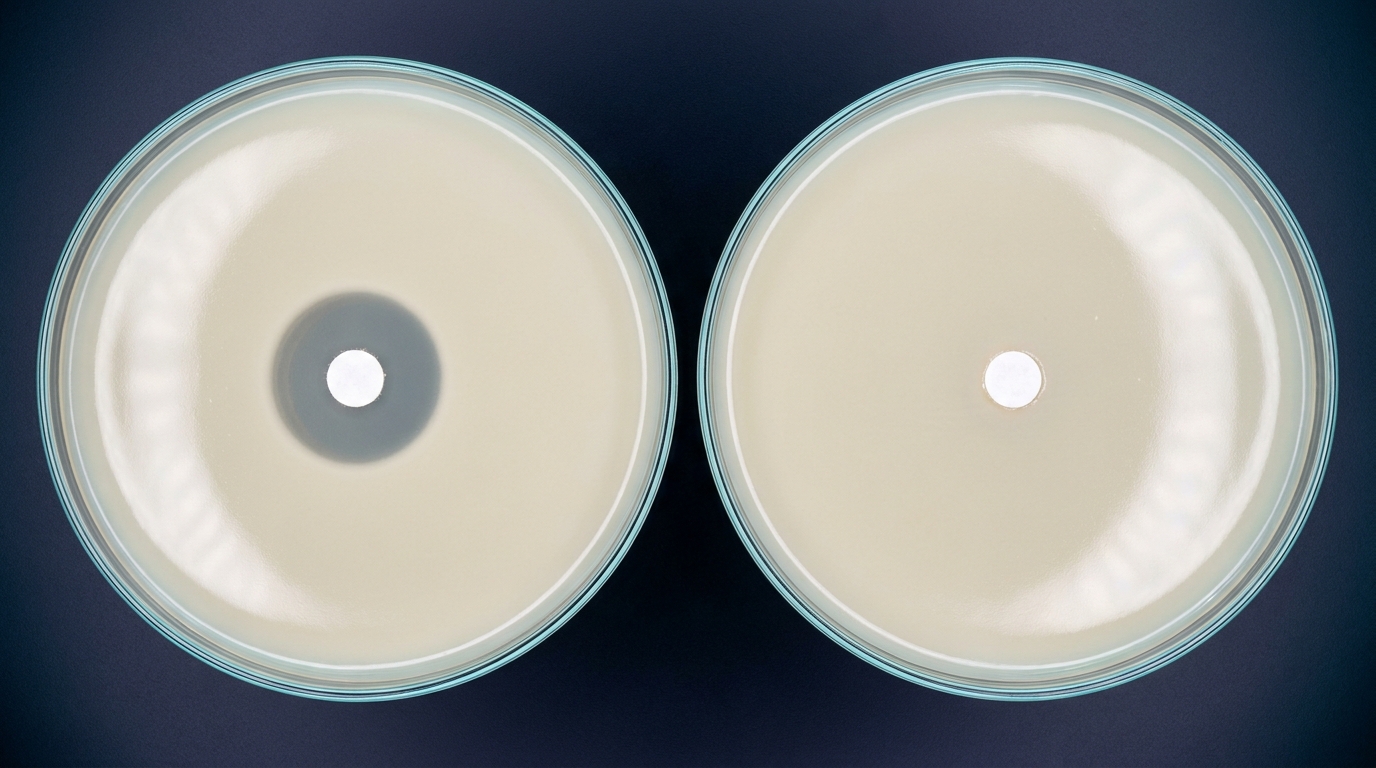
Zone of inhibition: a clear zone without bacterial growth around a sample on inoculated agar. It forms when an active substance diffuses from the sample into the agar.
Eluate: the liquid in which a sample has been stored for a leaching test. It contains everything the material released during that time.
What a zone of inhibition means.
In an agar diffusion test, the sample lies on a nutrient medium inoculated with bacteria, for example to ISO 20645 for textile fabrics or AATCC TM147, the parallel streak method [3, 4]. If an active substance diffuses into the agar, a zone without growth remains around the sample.
The width of the zone depends mainly on how well the substance moves through the agar. It says little about activity on the surface itself. A material that releases nothing produces no zone, even if it acts on contact [5].
A missing zone can therefore mean two things: contact activity or no activity. Only a contact test tells them apart. Conversely, a material that forms a zone may also act while bound.
Zone of inhibition and contact tests compared.
Both contact tests also pick up released substances. Whether the effect comes from the surface or from the eluate is only clarified by a leaching test.
| Feature | Zone of inhibition (agar diffusion) | ISO 22196 / JIS Z 2801 | ASTM E2149 |
|---|---|---|---|
| Principle | sample on inoculated agar | bacterial suspension under a cover film on the sample | sample in a shaken bacterial suspension |
| Duration, conditions | incubation on nutrient agar | 24 h, 35 °C, ≥ 90 % relative humidity | 1 h contact in buffer with constant shaking |
| Result | width of the zone without growth | antibacterial activity R, log difference to the untreated sample | reduction against control in % or log |
| Suitable samples | textiles, films, flat samples | plastics and other non-porous surfaces | fibres, textiles, powders, irregular shapes |
| Detects bound actives | no | yes | yes |
| Shows release | yes | no | no, cannot be distinguished according to the standard |
Literature
Advantages and disadvantages.
| Leaching | Non-leaching | |
|---|---|---|
| Advantages | also acts in gaps and in the surroundings · release is easy to detect | no loss of active substance through release · no active substance in the surroundings, food or tissue |
| Disadvantages | reservoir runs out · substance reaches tissue, food or wastewater · migration and exposure need assessment | acts only on direct contact · deposits can cover the surface · needs a suitable test method |
| Typical classes | silver ions, dissolved biocides, antibiotics | surface-bound quaternary ammonium compounds, grafted cationic polymers, photocatalytic layers |
Literature
Why the difference matters.
- Durability. A leaching system uses up its reservoir. Silver-treated textiles, for example, release silver during washing; how much depends on the type of treatment [13].
- Contact with people and food. Whatever leaves the material counts as migration for food contact and forms part of the biological evaluation for medical devices [9, 10].
- Environment and labelling. Released substances reach wastewater. The Biocidal Products Regulation assesses each active substance per product-type, and treated articles that carry a claim need a label [12].
How leaching is measured.
01
Place the sample in a medium that matches the application, such as water, a food simulant, artificial sweat or urine.
02
Take eluate samples at set time points, for example after one day, one week and one month.
03
Analyse the eluate chemically
metals, for example, by ICP-MS, organic actives by chromatography.
04
Test the eluate microbiologically. If it inhibits growth on its own, a released substance is at work.
05
Test the leached sample again with a contact method. If the effect remains, this points to a non-leaching component.
Seven questions for your supplier.
Does the material release active substance, and if so, how much, into which medium and over what period?
Which test proves the performance: standard, organisms, contact time, conditions, laboratory and date?
Was performance tested again after ageing, cleaning or washing?
How does performance change when the surface is soiled, for example with protein or grease?
Which active substance does the material contain, and is it approved or under review for the product-type [12]?
Which substances can migrate into food, onto skin or into tissue, and under which rules is this assessed, such as Regulation (EU) No 10/2011 or ISO 10993 [9, 10]?
How is the product labelled if a biocidal property is claimed?
For your product
What this means for your product.
For textiles, the site of action determines the test: ISO 20645 detects only released substances, while ISO 20743 measures the antibacterial activity of the textile itself [3, 11]. For Z-Chitosan, release behaviour is tested for each material.